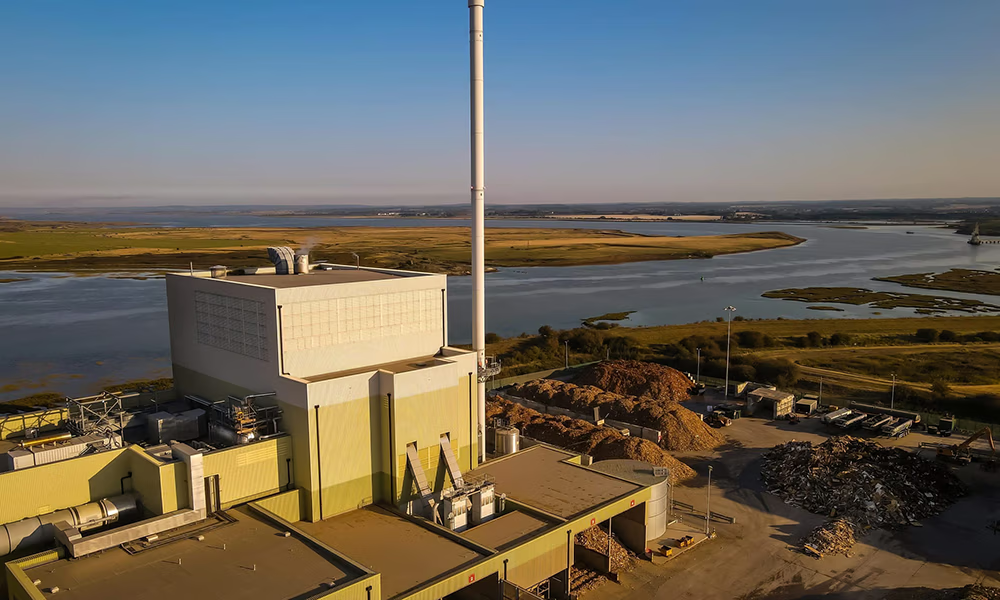
A collaborative approach to resources that enables the wastes and by-products of one organisation to be used productively by another, relies on good partnerships. Andrea Lockerbie explores how these partnerships work.
A data centre and an aquaculture facility for trout production demonstrate one of the latest examples of cross-sector collaboration that allow one organisation’s ‘waste’ to be used productively by another. In this case, in an industrial area in Rjukan, Norway, Green Mountain’s data centre is supplying its excess heat to Hima Seafood’s neighbouring fish production facility.
Torkild Follaug, Sustainability Director at Green Mountain Data Centres explains: “The opportunity emerged from a unique combination of geographical proximity and shared ambitions around sustainability. Green Mountain has operated its TEL-Rjukan data centre since 2014 and had long been exploring opportunities to put excess heat from its operations to productive use.”
“When Hima Seafood began developing its land-based trout farming facility in the same industrial area, just 800 metres from the data centre, the potential for collaboration became apparent. By connecting the two facilities through underground pipelines, excess heat from the data centre could support stable water temperatures in fish production, creating value from a resource that would otherwise go unused.”
Hima Seafood’s facility began operation in autumn 2025. Using the excess heat from Green Mountain’s cooling process to support stable water temperatures at the trout farming facility reduces its need for additional electricity for heating.
The system currently operates with a heat reuse capacity of up to approximately 1.75 MW during the first phase, while the partners build operational experience and evaluate opportunities for expansion. A second phase aims to scale the heat reuse capacity to up to 8 MW.
Follaug says: “One of the biggest successes has been proving that this type of industrial symbiosis can work in practice. The project has moved heat reuse from concept to reality and established a functioning circular energy system between two very different industries. The collaboration has also attracted significant interest from policymakers, industry stakeholders and international media.”
“As with any first-of-its-kind project, an important focus during the initial phase has been gaining operational experience, understanding maintenance requirements and analysing energy performance. The partners deliberately adopted a phased approach to allow both companies to learn from the first stage before scaling the system further.”
Physical proximity of the partners is important because it makes heat transfer technically and economically viable. However, Follaug flags that several other factors have been equally important:
- A shared commitment to sustainability and resource efficiency.
- Long-term planning and willingness to invest in innovative solutions.
- Strong trust and collaboration between the two organisations.
- A phased approach that allows both parties to gain experience before scaling.
- Compatible operational needs, where excess heat from one organisation becomes a valuable resource for the other.
Hima Seafood CEO Annar Bøhn previously explained: “Everything was already in place for this collaboration, both technically and culturally.”
Bøhn has described the collaboration as ‘a true win-win’ that reduces its energy consumption, improves its environmental footprint and strengthens the robustness of its operations, as well as one that will influence how the business thinks about future facilities.
The partnership was structured around a phased development model.With phase one focusing on implementing the heat reuse solution, gathering operational experience, and evaluating energy, technical and economic performance.
The agreement also establishes principles for transparency, collaboration and knowledge sharing between the parties. Insights from the first phase will inform decisions regarding future expansion and the larger second phase of the project.
A clear division of responsibilities and costs is included in the agreement. Green Mountain funded and now manages the infrastructure on its property, while Hima Seafood is responsible for the infrastructure on its site.
Follaug says: “One key lesson is to start by identifying complementary needs rather than focusing only on technology. Successful industrial symbiosis occurs when one organisation’s by-product can solve a challenge for another.”
“Another lesson is the importance of taking a long-term view. Building trust, aligning objectives, and gaining operational experience are just as important as the technical solution itself.”
A phased approach ‘can be highly valuable’, he adds.
“Starting with a smaller-scale implementation allows partners to validate assumptions, collect data and build confidence before making larger investments. The Green Mountain and Hima Seafood collaboration demonstrates how organisations from entirely different sectors can create new value by sharing resources and thinking beyond traditional industry boundaries.”
Leading the way

Kalundborg Symbiosis in Denmark is often considered the world’s first and leading example of industrial symbiosis, having been in operation since 1972. It started with a gas refinery that had excess energy and a plasterboard company setting up across the road that needed an energy supply.
Over time, industrial companies in the area organically developed mutually beneficial relationships, but it was only in the 1990s that Kalundborg gained widespread attention, after students from a local school interviewed the companies in the area for a project on sustainability and unearthed the network of exchanges and agreements that were in place for wastes and by-products.
Their work helped the various site managers take a step back from their individual operations and see the wider, local ecosystem of industrial symbiosis that was already in place around them.
The students – who later won an award for their project – built a small model of the system and presented their findings at a symposium at the school that was attended by the local paper. That led to articles in the national paper and, later, the Financial Times.
Today, the companies in the cluster share over 30 material streams and the group operates as a member organisation which shares its knowledge worldwide and charges for guided symbiosis tours.
Lisbeth Randers, former head of secretariat for the Kalundborg Symbiosis, has spoken on The Circular Economy Show podcast about some of the challenges involved with industrial symbiosis and the need to collaborate not just on the physical streams, but the shaping of legal and economic frameworks.
She said: “Creating a symbiotic collaboration is quite complex, [it] also involves that you look at your supply security: if this stream will someday terminate, what is your Plan B? How can you allow your partners to be warned [in a timely fashion] about this termination? It requires a local capacity to design those agreements.”
She also highlighted the importance of the financial incentives in these partnerships: they work because it makes good business sense for companies to save money on sending material to disposal or creating value from something they don’t need; and there is a business case for investments that bring longer-term benefits around environmental protection and protection of local resources.
UK exemplar
In the UK, a group of industrial businesses located in Kemsley, North Kent, has a similar sounding story to Kalundborg. Over the years, businesses in the area – MW Environment Ridham, enfinium, Knauf UK & Ireland, DS Smith Paper and Heathcote Holdings – organically developed bilateral partnerships and agreements; for example, the enfinium EfW facility provides steam to DS Smith for its operations.
But it was the more recent involvement of the University of Kent, initially through a student project, that led to all the businesses coming together to develop a simulation model of their energy production and consumption.
The student saw that the businesses were a great example of industrial symbiosis in action. This first project led to the group’s successful application for funding from the Government’s Local Industrial Decarbonisation Plans (LIDP) competition, with Mace managing the LIDP project and the university bringing its expertise in modelling and systems thinking.
The result of that project was The North Kent LIDP Report, published in 2025. The report, which maps out current and possible future exchanges, found that if technologies are implemented as modelled, the cluster can achieve a projected net negative carbon outcome.

Output from the modelling project suggests that if the Cluster were to combine their proposed decarbonisation strategies with carbon capture, it could achieve more than 500,000 tCO2 per annum of carbon removal from the atmosphere. From 2043 onwards, there’s the potential for the Cluster to cover the decarbonisation targets of the whole of Swale. It’s a case of having greater impact as a collective.
For the authors of the report, the cluster is seen as a potential leader in industrial symbiosis, offering a model for replication across the UK. Kathy Kotiadis, Professor of Operational Research in the Department of Analytics, Operations and Systems at the University of Kent, describes the cluster as an example of industrial symbiosis in its ‘purest’ form due to the geographic proximity of each of the businesses.
The involvement of the university brought the companies together as a group, and through workshops and facilitation the group was able to share knowledge and expertise, map its exchanges and identify future options to work together.
According to Professor Kotiadis, the project marked a fundamental shift for the businesses: they now identify as a cluster whereas previously they did not. Since the project ended, the group have continued to meet and talk.
“It’s very much a change in the mindset. [The companies] created a new cluster identity, a new symbiotic identity, and it is important. They see the benefit, and I feel that we started something for them, as a university, that they have continued,” she says.
Being a cluster has also brought more visibility and awareness to the group, as well as being seen very positively by Kent County Council. The university is looking for more funding to expand the cluster and to explore these relationships.
For Kotiadis, an expert facilitator, such as a university, is well placed to do this, as it brings the skills and training, from designing and managing workshops, to conflict management, information dissemination and strict management of data – including the ability to keep data safe and confidential, for example, using models that show group outputs without revealing the individual input data.
She sees a role for regional councils and regional government to bring such groups together to have conversations they otherwise might not have, and she believes more could be done towards identifying potential clusters.
“Industrial symbiosis is the perfect starting point towards decarbonisation: you should look at all your exchanges, the possibilities, and try and improve these, before you move towards decarbonisation,” she says.
During the project with the North Kent Cluster, Kotiadis showed them videos and information from the Kalundborg symbiosis in Denmark. She believes the cluster in Kemsley is a perfect example of industrial symbiosis in the UK and that such examples should be promoted, shown and explained to others so that the concept is better understood and more widely implemented.
If the funding was available, she would love to see the North Kent Cluster as a ‘living lab’ like Kalundborg Symbiosis, that people could visit to better understand industrial symbiosis in action, and in turn accelerate the path to decarbonisation.
She adds that government backing of industrial symbiosis and greater use of the terminology, as well as putting people with the right expertise in place to help unlock more symbiotic partnerships, is needed.
As a modelling and systems thinking expert, the North Kent Industrial Cluster project exposed Kotiadis to the beneficial impacts of industrial symbiosis – and the even greater potential that has yet to be unlocked.
